

The Gene Keys Explained
A practical guide to a very mystical system

Editor’s Note 2026: When I first published “The Gene Keys Explained” in June 2024, one reader wrote, “Once I found this, I finally realized I’m not crazy.” I felt the same way when I discovered this work. Since then, more and more leaders and high‑functioning humans have been asking for a clearer, more practical doorway into the Gene Keys. This is that doorway—an executive‑friendly, still‑mystical companion to the original deep‑dive.
Who this is for
If you’ve bumped into Gene Keys through a friend, a podcast, Human Design, or some late-night rabbit hole, you’re probably wondering: “What is this, and is it legit or just more spiritual fluff?”
At its core, the Gene Keys are a pattern-recognition system for your life: they give you a language for your recurring challenges, your default reactions under stress, and the higher potentials hidden inside those patterns. Instead of telling you who to be, they offer a map for how you already operate, and how to move from survival mode into contribution and purpose.
I’m a certified Gene Keys Guide and have been contemplating and working with this material for years. What follows is my way of explaining it—simple, practical, and grounded enough that a skeptical, high-functioning professional can actually use it.
If you’re new to astrology or Human Design, Gene Keys may feel like a lot at first. I recommend having at least a basic grasp of Western astrology (planets, signs, houses) and your Human Design type/authority, but it’s not mandatory. You can absolutely start here, take what resonates, don’t take my word for it, experiment, leave the rest.
A quick origin story
The Gene Keys emerged through Richard Rudd, who experienced a powerful spiritual awakening in his late twenties after years of deep work with the Human Design system. Human Design itself was a transmission received by Ra Uru Hu and combines astrology, the chakra system, the I Ching, and other esoteric lineages into a single framework.
Richard took that base and created another synthesis: the Gene Keys. They weave together the I Ching, astrology, Human Design, and the chakra system into a contemplative map for your inner life. The promise is simple but profound: to guide you back to who you actually are beneath conditioning, roles, and expectations.
You’re not asked to “believe” in it. You’re invited to test it against the real data of your life. Do the patterns it describes show up for you? Does working with them make your life more honest, spacious, and effective? That’s the only metric that matters.
The Gene Keys approach: a hidden professional framework
The Gene Keys aren’t meant to be “studied” in a purely intellectual way. They’re meant to be lived. The core approach is described as:
🧘 Contemplation → 🧐 Inquiry → 🪶 Gentleness → 🐢 Patience
On the surface this sounds spiritual, but it’s actually a powerful professional development framework:
Inquiry – Instead of accepting labels at face value, you ask: “Is this true for me? Where do I see this pattern in my actual behavior?” This is the same skill great strategists and leaders use: rigorous self-questioning.
Contemplation – You don’t rush to conclusions. You carry a question into your day—into meetings, conflict, creative work—and watch how it plays out in real time.
Gentleness – You notice your patterns without shaming yourself. This is essential if you want genuine change instead of performative self-improvement.
Patience – You allow new behaviors and perceptions to grow at their own pace, the way roots establish before a tree appears above ground.
In my own profile, everything begins with inquiry—my Evolution sphere is Gene Key 61.1, “The Gate of Mystery,” which describes a person wired to constantly ask why. For you, contemplation or gentleness may be the starting point. The order is less important than the fact that you’re willing to cycle through all four, again and again, as your life unfolds.
Treat this like a long-term experiment. Give it more than a week. Watch what shifts when you apply inquiry, contemplation, gentleness, and patience to one specific pattern in your life.
What is a Gene Key?
Each Gene Key is:
An archetype that describes a particular pattern of consciousness
One of 64 “codes” that mirror the 64 hexagrams of the I Ching and the 64 codons of human DNA
Linked to a specific area of your life via your hologenetic profile
Every Gene Key in your profile comes with:
A shadow (your survival pattern)
A gift (your creative potential)
A siddhi (the highest, almost transpersonal expression)
Think of the shadow as your default operating system when you’re stressed, afraid, or on autopilot. It’s not “bad”; it’s simply the contracted version of you. The Gene Keys invite you not to bypass the shadow but to walk through it, because every shadow contains the seed of its own gift.
The siddhi is what that same energy looks like fully opened—a kind of inner genius or grace that’s difficult to articulate but unmistakable when felt.
A concrete work example, Gene Key 21
Imagine a leader whose Life’s Work Gene Key has a shadow of Control
The Gene Key 21 spectrum moves from Control (shadow) to Authority (gift) to Valor (siddhi).
At the shadow level, Control shows up as a deep‑seated need to manage circumstances, people, or resources from fear, insecurity, or a desire for safety. Control becomes rigid, domineering, or overly restrictive, driven by a belief in separation and a lack of trust in life’s natural flow. It reinforces a sense of inadequacy: the more you fear losing control, the more tightly you grip, and the more tension you create in yourself and others.
In a leadership context, that looks like micromanaging, reluctance to delegate, and an unspoken message of “I don’t trust you,” which stifles initiative and burns people out.
The gift of Authority is the same energy transmuted into grounded, responsible leadership. Instead of controlling every detail, you set clear boundaries, make firm decisions, and take ownership for outcomes while allowing others real autonomy. People experience you as stable, trustworthy, and fair.
At the siddhi level, Valor emerges as noble, selfless stewardship and courage in action: using your will and position not to dominate, but to protect, uplift, and serve something larger than your personal agenda.
As Richard Rudd describes it, the journey through Gene Key 21 is from Control → Authority → Valor—the shadow of control is the primary obstacle, but also the doorway, to awakening the higher gift and its ultimate expression of nobility and communion.
From the outside, this looks like leadership development. On the inside, Gene Keys gives that leader language for their pattern and a contemplative path for transforming it.
The profile: your hologenetic map
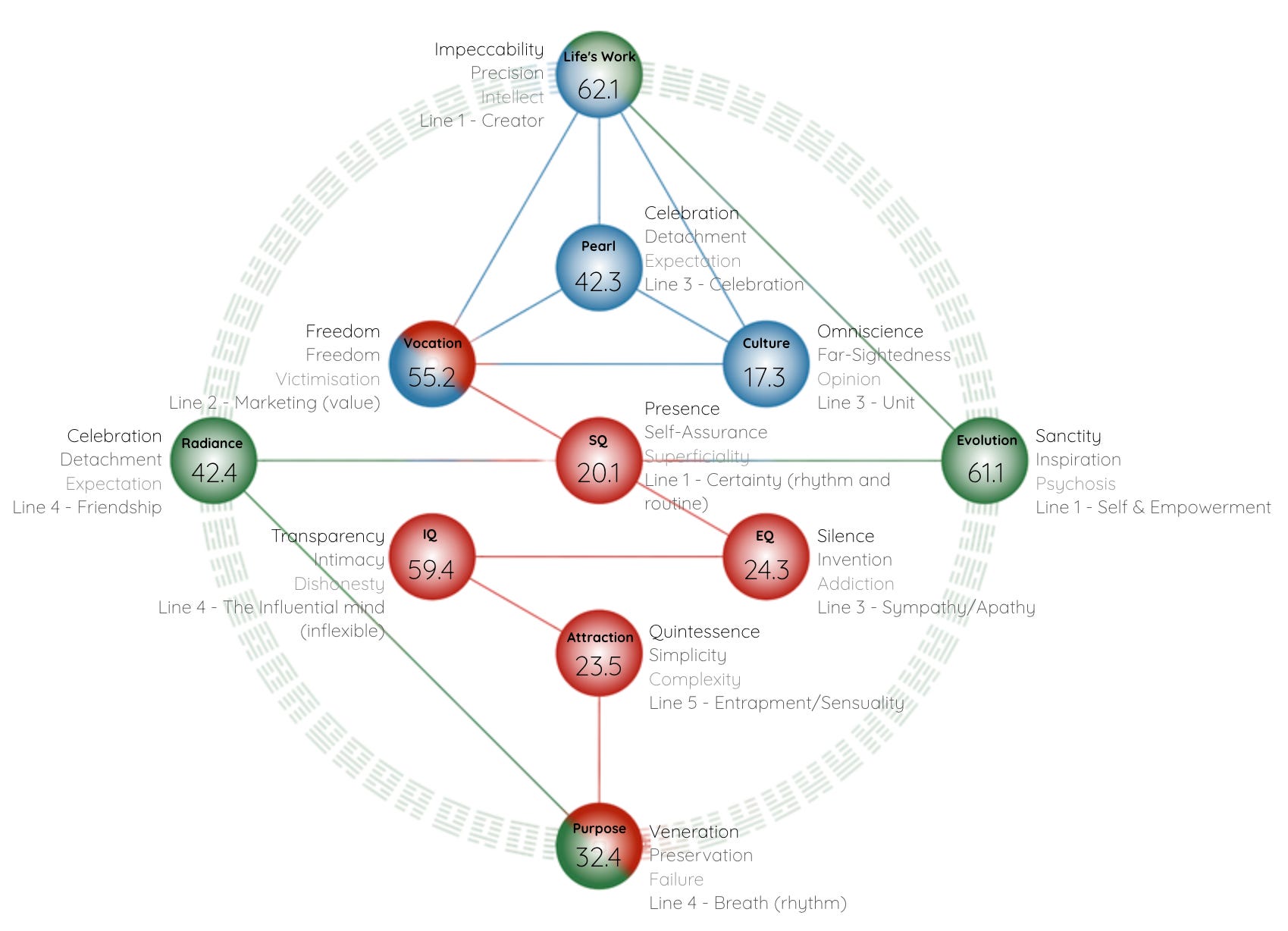
Your hologenetic profile is a personalized map of 11 spheres connected by pathways. Each sphere corresponds to a part of your life—your vocation, your relationships, your purpose, your core wound—and each is expressed through a specific Gene Key and line.
The first number is the Gene Key.
The number after the dot is the line, which flavors how that archetype shows up in you.
Some spheres are conscious (tied to planetary positions at your birth) and tend to be obvious to you and others, such as your Life’s Work and Evolution. Others, like Radiance and Purpose, are unconscious, linked to your design date about three months before birth, and often feel like hidden or slowly revealed gifts.
Even if two people share the same Gene Key in a sphere, their lines can make the expression feel completely different.
The lines: how your archetypes behave
Lines are the “personality” of each Gene Key in your profile. There are six, and they follow the same logic as the I Ching and Human Design:
Lines 1–3: more personal, focused on internal processing and self.
Lines 4–6: more transpersonal, focused on impact, networks, and the collective.
If you’re unsure of your exact birth time, you may see more than one possible line for a given sphere. My suggestion: study each, notice what actually shows up in your life, and be honest about what feels uncomfortably accurate versus aspirational. The temptation to identify with the “nicer” line is real—watch for that.
I’ve summarized the lines in more depth in a separate table and article, but you can think of them as how each archetype moves: inward or outward, fixed or experimental, self-focused or network-focused.

Programming partners: the built-in tension
In both the Activation Sequence and Human Design, certain Gene Keys come in pairs called programming partners. These pairs sit opposite each other in the I Ching/Gene Keys wheel and create a kind of push–pull dynamic:
Life’s Work ↔ Evolution
Radiance ↔ Purpose
At the shadow level, programming partners tend to trigger each other: when one shadow is active, it often sets off the other. At the gift and siddhi levels, they work together in a kind of synarchy—distinct but harmonized expressions of the same underlying energy.
For example, in my own profile, my Evolution Gene Key 61 and my Life’s Work Gene Key 62 sit directly opposite each other on the mandala. Watching how those two play out together has been one of the most accurate mirrors of my actual challenges and strengths.
When you contemplate the Venus and Pearl sequences (relationships and prosperity), looking at programming partners gives you deep insight into the “axes” your patterns tend to swing along. It helps you recognize the predictable ways you might sabotage yourself—and where the biggest breakthroughs are hiding.
If this gave you a clearer, more grounded picture of the Gene Keys, you’re ready to dive into your own profile and start experimenting. I am happy to recommend experienced guides you can connect with, just send me a message.